Nonlinear Systems
Topics in Digital Heritage:
Numerical Methods for Digital Reconstruction
Fall 2026
Continuity and Bisection
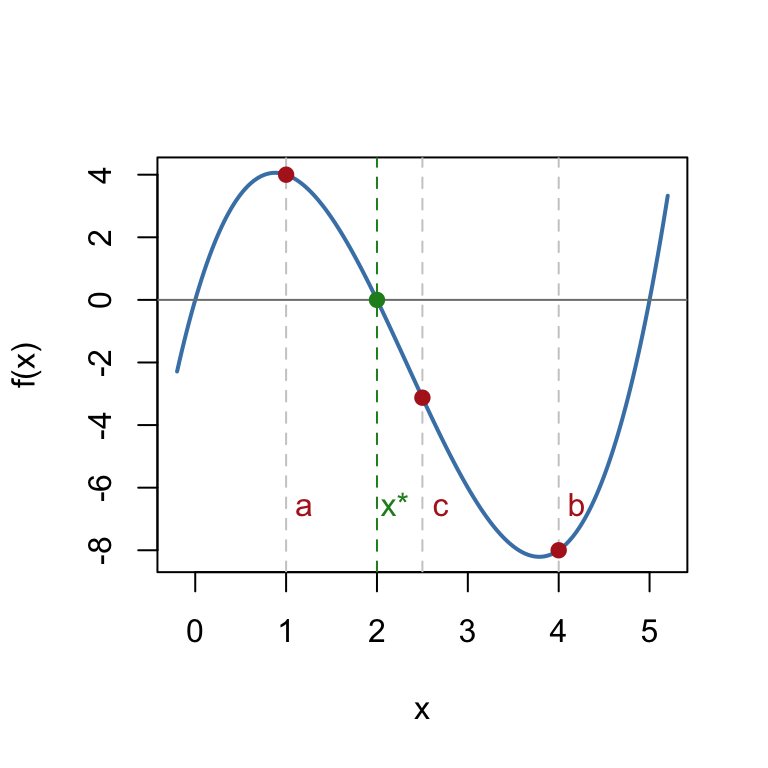
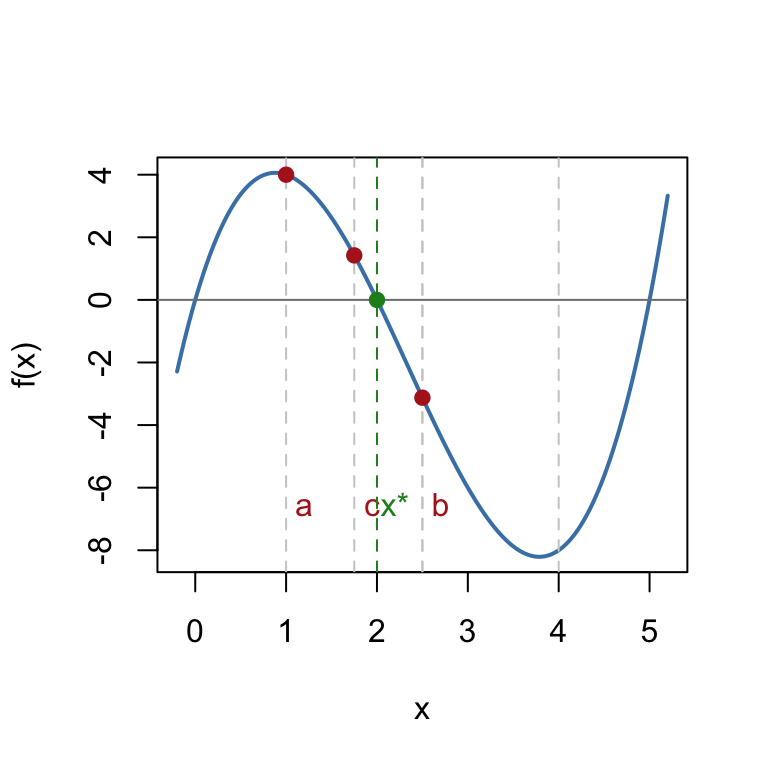
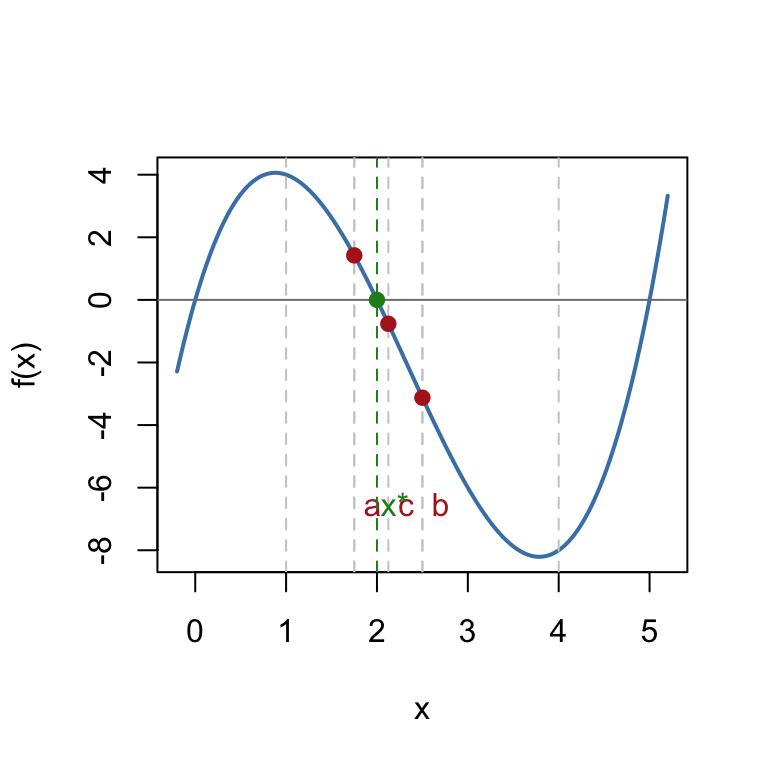
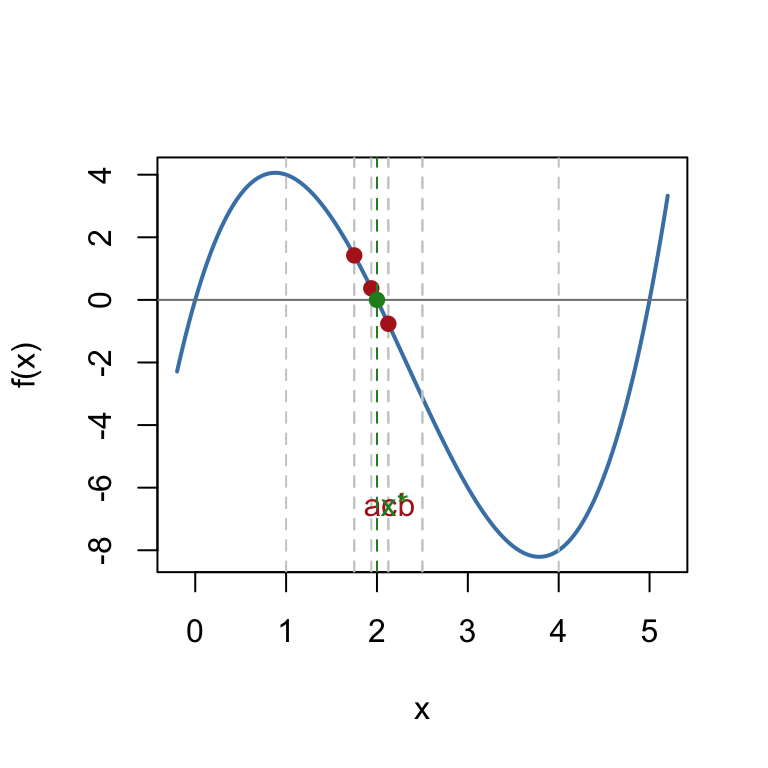
Intermediate Value Theorem
Suppose that \(f\) is continuous on the interval \([a, b]\) and that \(f(a) < \alpha < f(b)\) for some \(\alpha\). Then there exists \(x \in (a, b)\) such that \(f(x) = \alpha\).
Lipschitz and Fixed-point Iteration
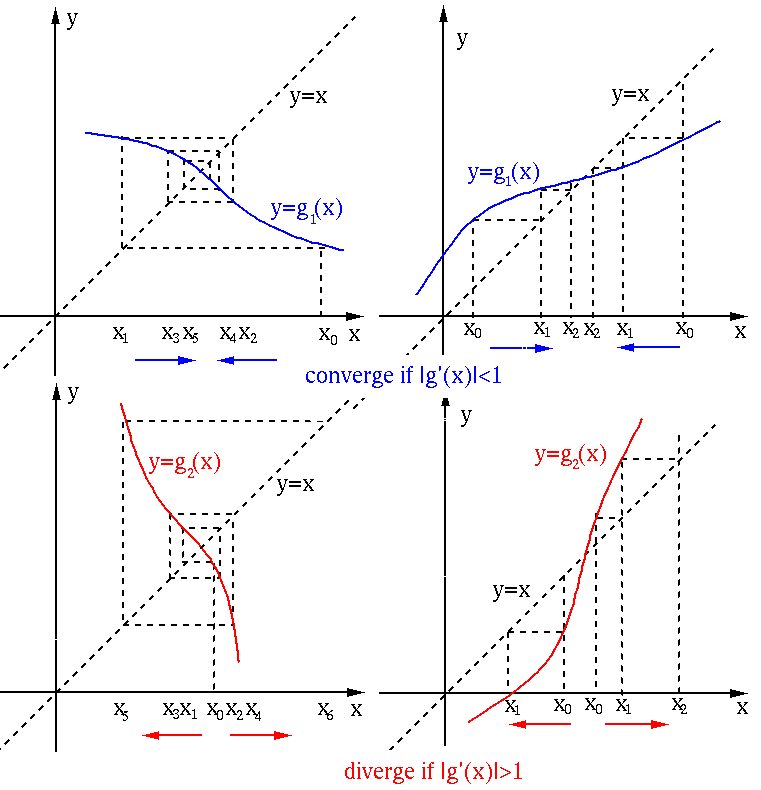
Suppose that we wish to find \(x^*\) such that \(g(x^*) = x^*\) and that \(g\) is Lipschitz continuous with constant \(0\leq c < 1\). Then we can use the fixed-point iteration:
- Choose an initial guess \(x_0\).
- Iterate \(x_{k+1} = g(x_k)\).
If this iteration converges, the resulting \(x_k\approx x^*\) is a fixed point of \(g\).
Differentiability and Newton’s Method
Taylor expansion
Suppose \(f\) is \(C^k\) continuous at \(x_0\). Then we can write the Taylor expansion of \(f\) around \(x_0\) as \[ f(x) = f(x_0) + f'(x_0)(x - x_0) + \frac{f''(x_0)}{2!}(x - x_0)^2 + \cdots + \frac{f^{(k)}(x_0)}{k!}(x - x_0)^k + \mathcal{O}((x - x_0)^{k+1}) \] where \(\mathcal{O}((x - x_0)^{k+1})\) is the remainder term that goes to zero faster than \((x - x_0)^{k+1}\) as \(x \to x_0\).
Attempt to solve \(f(x) = 0\) by using the first-order Taylor expansion of \(f\) around \(x_k\): \[ f(x) \approx f(x_k) + f'(x_k)(x - x_k) \] Setting \(f(x) = 0\) gives the Newton’s update: \[ x_{k+1} = x_k - \frac{f(x_k)}{f'(x_k)} \]

Secant Method
Evaluating \(f'(x_k)\) can be expensive or impossible. The secant method approximates the derivative using finite differences: \[ f'(x_k) \approx \frac{f(x_k) - f(x_{k-1})}{x_k - x_{k-1}} \] The secant method update is then given by \[ x_{k+1} = x_k - f(x_k) \frac{x_k - x_{k-1}}{f(x_k) - f(x_{k-1})} \]

- The convergence of the secant method is superlinear (between linear and quadratic) with order \((1+\sqrt{5})/2 \approx 1.618\) (the golden ratio).
Back to the Loan Example
Estimating Effective Interest Rate
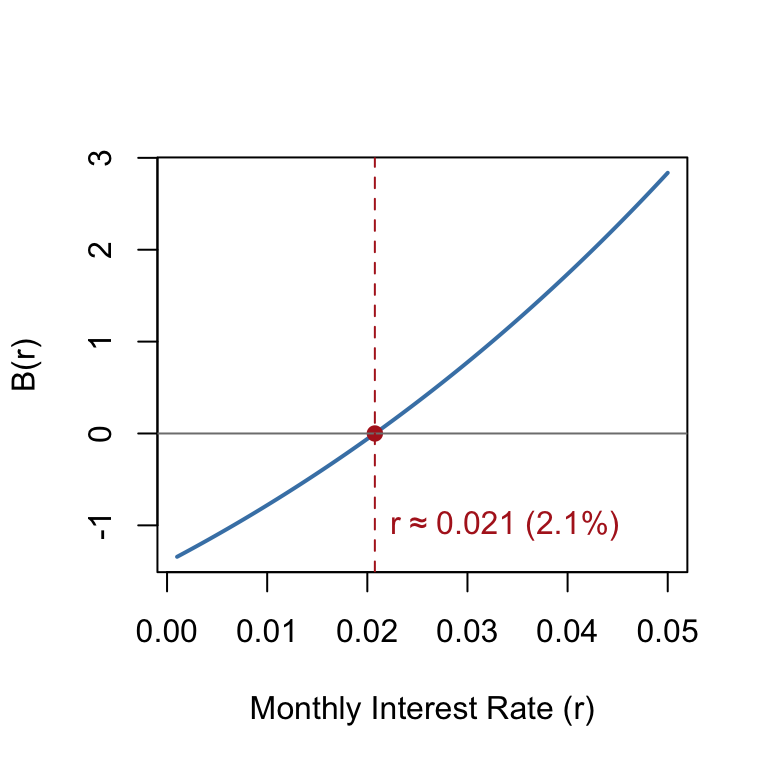
- \(B(r) = 10 \cdot (1 + r)^{12} - 0.95 \cdot \frac{(1 + r)^{12} - 1}{r}\)
- We want to find \(r\) such that \(B(r) = 0\).
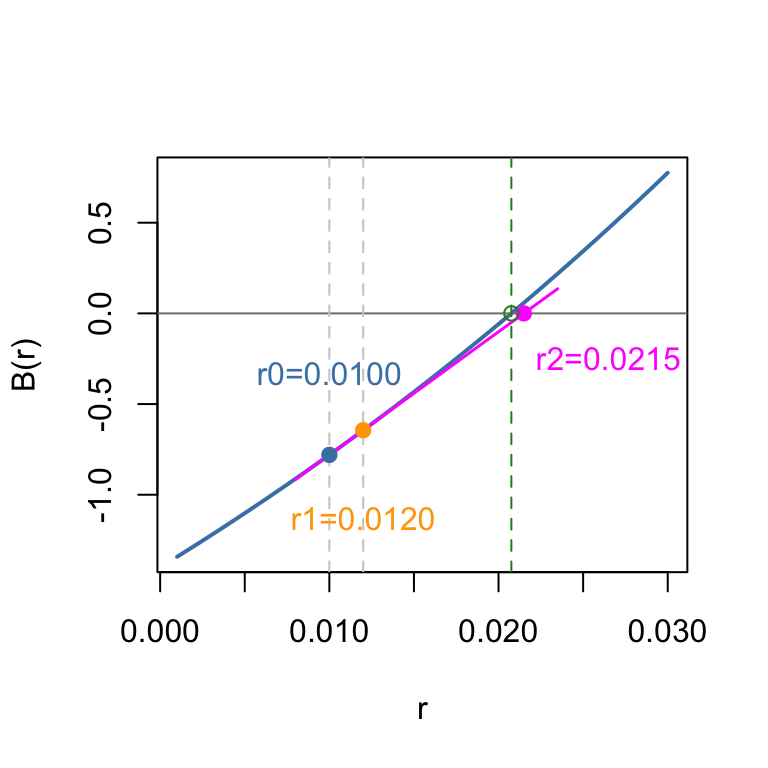
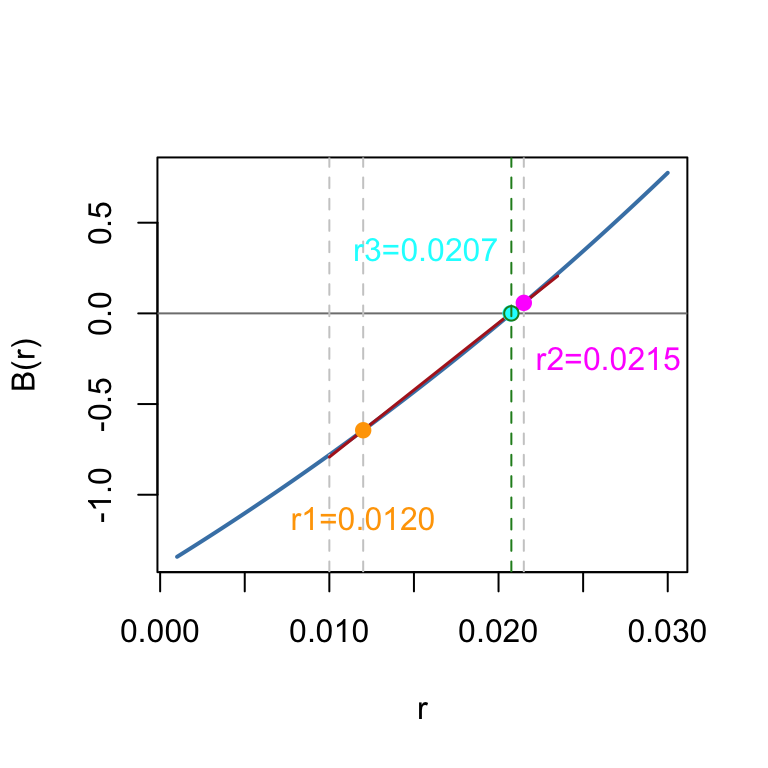
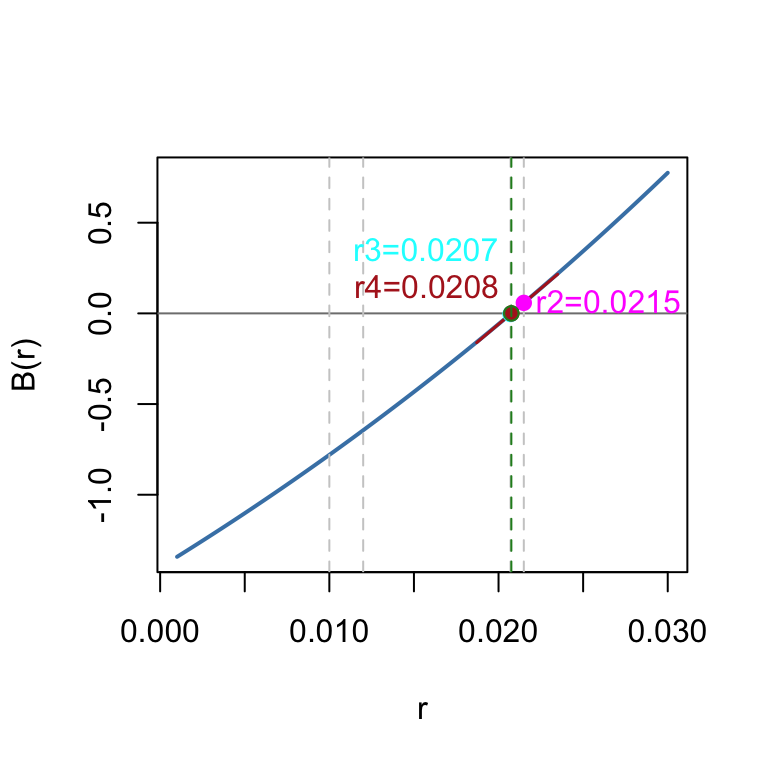
- Apply the secant method to find the root of \(B(r)\).
- Start with two initial guesses \(r_0 = 0.01\) and \(r_1 = 0.012\).
- Iterate using the secant method update until convergence.