I’ve conducted research aimed at improving the acoustic characteristics of speakers using dielectric elastomers. To achieve this, I designed a physics-based model to simulate the effects of variations in the input signal to the dielectric elastomer. more specifically, I’ve represented the deformation of the thin-film elastomer in response to its electrical signal as a nonlinear ODE. When a high-voltage is applied between the sandwiched electrodes, Maxwell stress is applied to the elastomer, which deforms in (visco-)hyperelastic manner. Based on this model, I proposed methods to enhance acoustic characteristics (nonlinear distortion).
Dielectric elastomer actuator array with single-pixel control
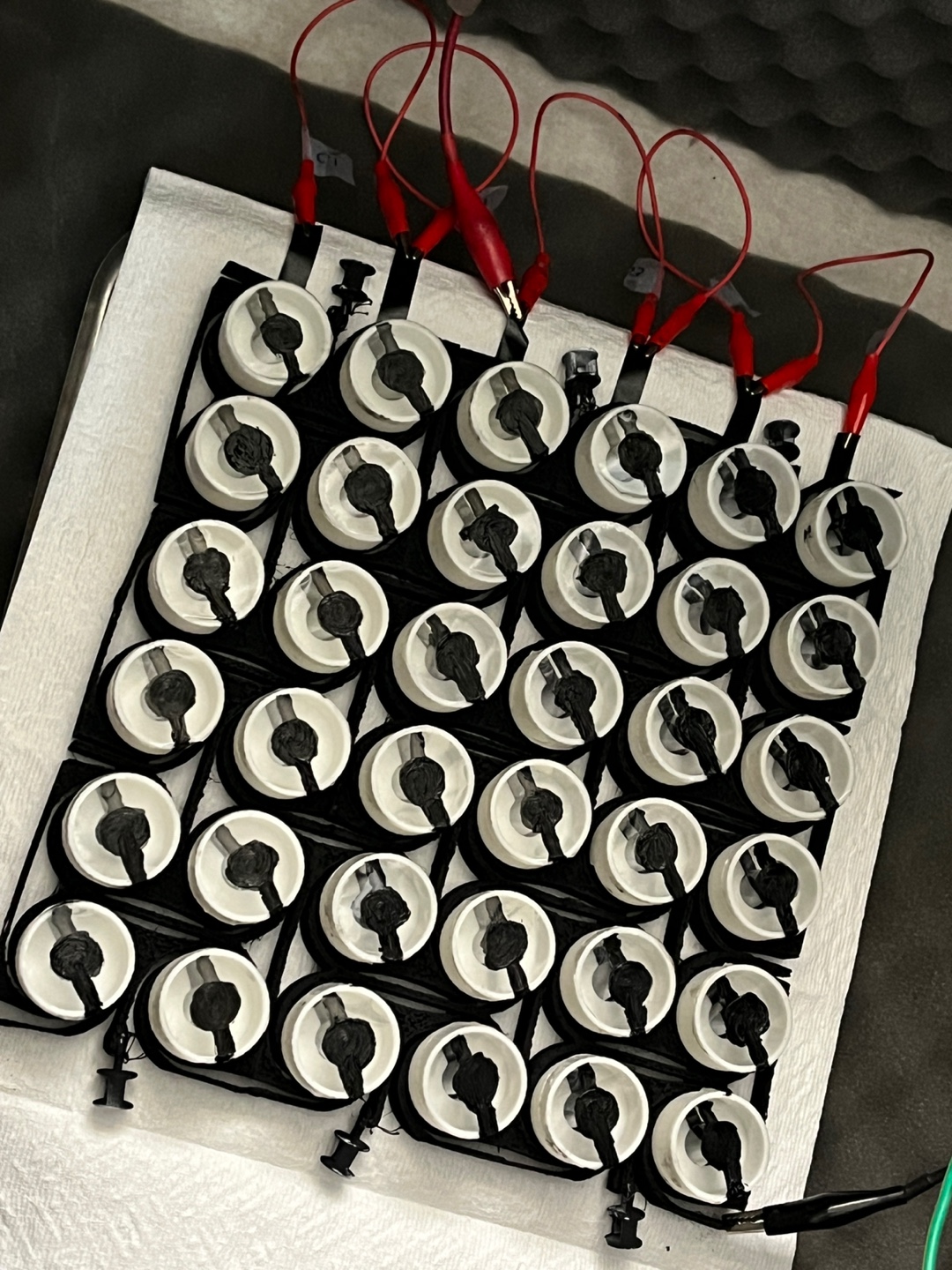
Dielectric elastomer actuator array mounted in deformable cavities
To demonstrate the effectiveness of the proposed model in reducing distortion, I measured the deformation and the resulting sound produced by fabricated and operated elastic speakers using sensors like microphones and LDVs. The proposed model was successfully validated by showing its capability to reduce distortion in the measured sound. More details can be found from this paper. Above pictures are two types of the experimented thin-film speakers, in an array structure. LHS is also equipped with photonic nanocrystal gel that changes its color according to its strain (so it visualizes the amount of the elastomer’s stretch).
